- February 4, 2026
- 7:48 pm
- 0 comments
If you’re wondering how to use a personal massager safely and effectively, you’re not alone. Most people unbox a personal massager, flip through a three-page pamphlet, and immediately start wondering whether they’re pressing too hard or using the wrong setting, and at Lovenjoy, one of the first questions customers ask before placing an order is how to actually use their new device correctly without hurting themselves. The good news is that getting this right doesn’t require medical training or a formal massage qualification. You need a clear process, and that’s exactly what this guide covers: device types, step-by-step technique for specific body areas, intensity settings, safety rules, cleaning protocols, and troubleshooting basics.
Whether you’ve bought a wand for sore shoulders after a long day at the desk or a compact vibrating massager for relaxation, the fundamentals apply across all devices. Read this once, apply it consistently, and you’ll get far better results from your device while avoiding the common mistakes that cause unnecessary bruising or skin irritation.
Know your device: the main types of personal massagers
Before you switch anything on, understanding what type of massager you own changes everything about how you use it. Different devices are engineered for different purposes, and pushing a percussion gun onto a delicate area designed for a compact vibrator is a reliable way to end up sore. The three main categories, wand massagers, percussion devices, and compact vibrating massagers, cover most products on the market, though specialised devices such as Shiatsu cushions and scalp massagers occupy their own niche.
Wand massagers and body-area vibrators
Wand-style massagers are large, typically rechargeable or mains-powered, and deliver strong, sustained vibration through a rounded head. They’re built for large muscle groups: the back, thighs, calves, and shoulders. Some wand models also feature body-safe silicone heads suited for intimate use. If your primary goal is muscle tension relief across a broad area, this is the most effective category.
Handheld percussion and compact vibrating massagers
Percussion or “gun-style” devices operate through rapid back-and-forth strokes rather than circular vibration, making them well-suited for deep muscle recovery after exercise. They’re popular for the neck, back, and thighs. Compact bullet-style and travel vibrating massagers sit at the opposite end: lighter, quieter, and designed for targeted spots or discreet personal use. These are the massagers most people carry in a bag or keep in a bedside drawer.
How to pick the right one for your need
Pain relief and muscle tension call for a wand or percussion device with sufficient power to penetrate deep muscle tissue. Relaxation and stress relief suit a lower-frequency vibrating massager with a softer broad head. For intimate personal use, body-safe materials are essential, silicone, ABS plastic, or glass only; avoid jelly rubber and PVC. Lovenjoy carries products across all three categories, available with discreet packaging for delivery across India.
How to use a personal massager step by step
Technique matters as much as the device itself. Two rules apply to every body area without exception: start on the lowest setting, and keep the device moving. A stationary massager held too long on one spot causes bruising. Check your device manual, your personal massager instructions, before the first session; it confirms the recommended attachments, session duration, and any model-specific restrictions.
Before you start: preparation and setup
Charge or plug in the device fully before your first session. Choose a comfortable seated or lying position where you can reach the target area without straining. Inspect the skin you plan to massage: cuts, rashes, or broken skin are a stop sign. Select a soft rounded attachment for larger muscles and begin at the lowest intensity. If you’re new to using a personal massager, keep the initial session to around 10 to 15 minutes, a conservative window that gives your body time to adapt before you gradually extend duration.
How to use a personal massager for neck and shoulders
Work only on the back and sides of the neck, along the upper trapezius muscles. Start at the base of the skull and glide downward using slow, small circles. Stay alongside the cervical spine, never directly over it. Avoid the front of the neck entirely. Major arteries run there, and vibration directly over them carries real risk. Use light pressure for about 1 to 2 minutes per side. For shoulders, place the device on the fleshy muscle between the neck and shoulder, sweep outward slowly toward the joint, and spend 2 to 5 minutes per side. Avoid the collarbone and the shoulder joint itself.
Back and feet technique
For the back, start at the lower back muscles and make slow circular or vertical passes alongside the spine, never over it. Work upward toward the shoulder blades and spend about 5 to 7 minutes total, keeping the device continuously moving. For feet, sit securely and work across the sole, heel, arch, and ball of the foot using slow passes. Treat each foot for 3 to 6 minutes, using lighter pressure over toes and ankles. After any session, reduce intensity gradually before switching off, then drink water and check for unusual redness or bruising.
Getting the settings right: modes, intensity, and lubrication
The single most common mistake beginners make is jumping straight to the highest setting. Higher intensity does not mean better results; it may cause delayed muscle soreness or muscle bracing in the hours that follow. Most massagers offer multiple speed levels and vibration patterns, and matching the setting to your goal makes a measurable difference.
Matching vibration frequency to your goal
For pain relief, steady mid-frequency vibration in the 100 to 150 Hz range works through the gate-control mechanism, competing with and reducing pain signals before they reach the brain. Use moderate pressure over the painful muscle, not directly over joints or bones. For relaxation, choose the lowest continuous setting, a soft broad head, slow movements, and light pressure. The objective here is soothing, not stimulating: if your muscles are tensing up rather than releasing, drop the intensity immediately.
Lubrication: when and what to use
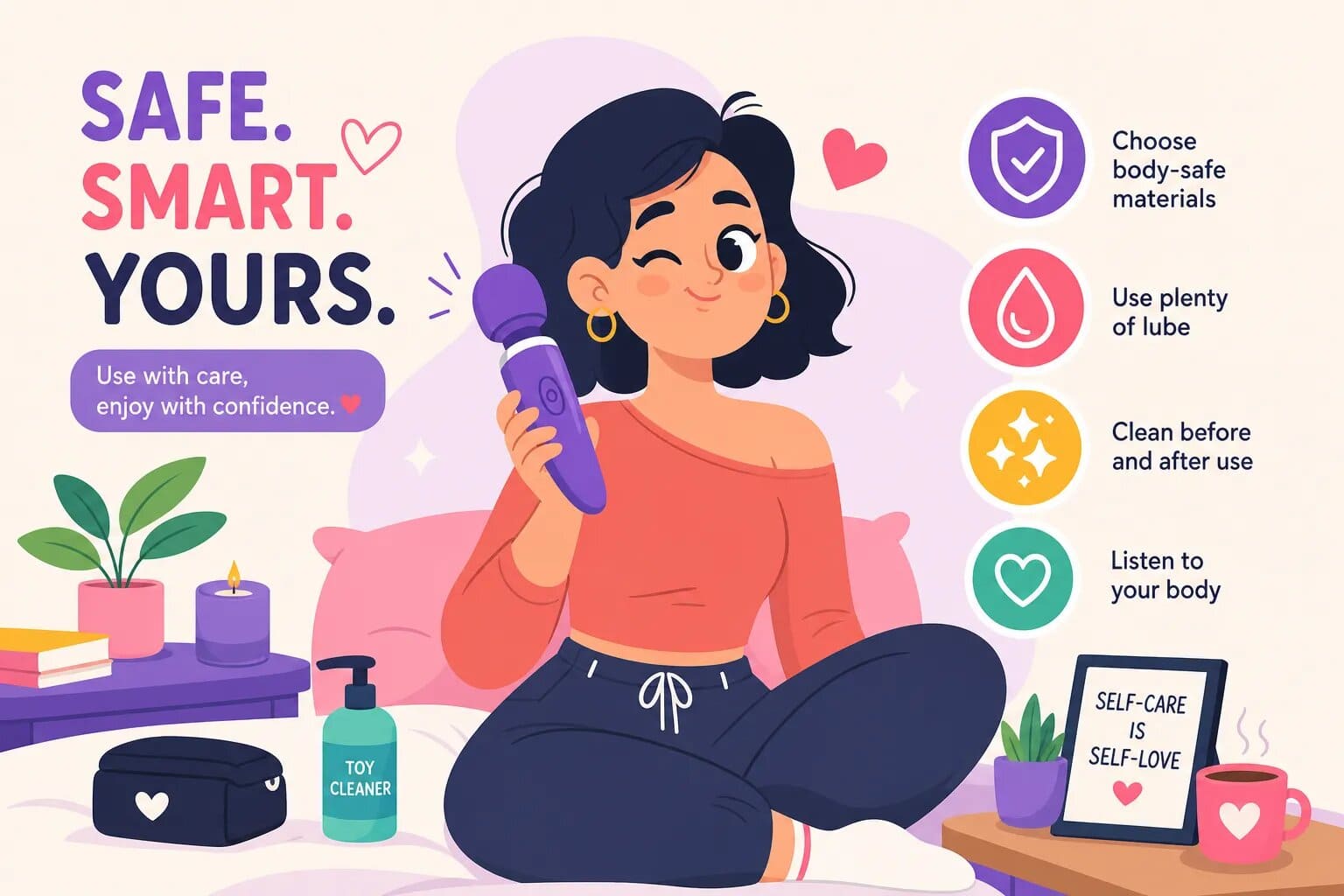
For external muscle massage over clothing or dry skin, no lubricant is needed. For intimate use or application on sensitive skin, always use a water-based lubricant with silicone devices. Silicone-based lubricants can degrade silicone toy materials over time, making the surface tacky, rough, or discoloured. Oil-based products carry the same risk. Avoid applying any liquid near charging ports, seams, or vents, regardless of the device’s waterproof rating.
How to use a personal massager safely: rules and who should be extra careful
A personal massager used incorrectly can cause bruising, nerve irritation, or skin damage. Understanding the boundaries beforehand means you get the benefits without the setbacks, it’s about using your device smarter, not avoiding it altogether.
Body areas and situations to always avoid
Never use a massager over the spine, the front of the neck, open wounds, rashes, active infections, varicose veins, fractures, or areas with reduced sensation. Avoid joints and bony prominences: these are not muscle tissue and cannot benefit from vibration in the same way. Do not use any electric massager near water unless the device carries an explicit waterproof rating for that environment. Never use the device while asleep, intoxicated, or unable to monitor your body’s response, and keep all devices out of reach of children.
Who should consult a doctor first
If you’re pregnant, this warrants a conversation with your obstetrician before any session. The same applies if you have a pacemaker or any implanted electronic device, are on blood thinners, live with diabetes or neuropathy, or are recovering from surgery. People with osteoporosis or cardiovascular conditions should also get clearance first. This is a one-time check before establishing a regular routine, not a reason to avoid using a massager permanently.
Signs to stop the session immediately
Sharp pain, numbness, dizziness, burning, unusual skin discolouration, or swelling are all signals to switch the device off at once. Note the area where the sensation occurred and assess whether the issue resolves within a few minutes. If it doesn’t, or if it returns during the next session, seek medical advice before continuing.
Cleaning, storage, and keeping your massager in good condition
Hygiene before and after every session is the standard, not an occasional extra step. Skipping it allows bacterial build-up on the device surface and can accelerate material degradation, both of which shorten the life of the device and create unnecessary skin risks.
Personal massager safety and cleaning: waterproof ratings explained
Non-waterproof devices need only a damp cloth with mild soap on the outer surface; do not rinse them under running water. An IPX4 rating handles splash exposure only. IPX6 can be rinsed under running tap water. IPX7 allows brief immersion up to 1 metre for 30 minutes, but only when all seals and charging covers are properly closed. A cracked casing, open charging port, or missing seal cap drops any device to non-waterproof status, regardless of what the label says. Avoid alcohol, acetone, and abrasive cleaners unless the manufacturer explicitly approves them for your specific model.
Charging and storage
Always use the supplied charger, charge in a cool ventilated area with the device switched off, and unplug once fully charged. For long-term storage, keep the battery at roughly 50 to 60% charge and top it up every six months. Store the device completely dry in a fabric pouch or ventilated case, away from direct sunlight, heat sources, and other silicone or rubber products, which can cause surface tackiness over time. Inspect periodically for cracks, swelling, or damaged cables. If the battery swells, overheats, or produces an unusual smell, stop using the device immediately.
Troubleshooting common problems and using a massager with a partner
Most device issues have straightforward fixes. Here are the three most common problems to check before concluding that the massager is broken, and what each symptom usually means.
Fixing the most common device problems
No power: check the charging port for damage, confirm the power switch is fully engaged, and test with a known-good charger. Weak vibration: recharge the battery fully, confirm you’re on the correct speed setting, and check that vents aren’t blocked. Unusual noise: switch off immediately and inspect for loose parts, foreign objects, or grinding sounds from the motor. Do not continue operating a device that grinds. If the massager sparks, produces a burning smell, or delivers a shock, stop using it at once and do not attempt to open or repair it yourself.
When to replace rather than repair
Replacement makes more practical sense than repair when the motor or main circuit is confirmed damaged, repair costs approach the price of a new unit, or the device has failed repeatedly. Lovenjoy carries a range of body-safe replacements across all major categories, available with discreet packaging and multiple payment options including UPI and cash on delivery.
Using a massager with a partner
Couples can use a wand or handheld massager for shared relaxation: alternating back massages, targeting specific tension spots, or simply making the experience more connected. For intimate couples’ use, choose a body-safe device designed specifically for that purpose, use water-based lubrication, and clean the device between uses or use a barrier. If you’re unsure which product suits your needs as a couple, the Lovenjoy team is available to help you choose, reach out via the contact details on the website for guidance without any awkwardness.
Start simple, stay consistent
Using a personal massager correctly comes down to a few consistent habits: know your device type and start at the lowest setting, keep the device moving at all times, and match the intensity and attachment to your goal. Clean the massager after every use and stop the session immediately if anything feels wrong. Once these become second nature, the results speak for themselves.
Lovenjoy’s range of body-safe personal massagers is available for delivery across India in plain, discreet packaging. Whether you’re a first-time buyer or upgrading from an older device, you can explore the full selection and pay via UPI or cash on delivery. If you’re unsure which massager suits your specific needs, reach out to the Lovenjoy team for a confidential consultation and get a recommendation you can trust.
Related posts
 For Her

