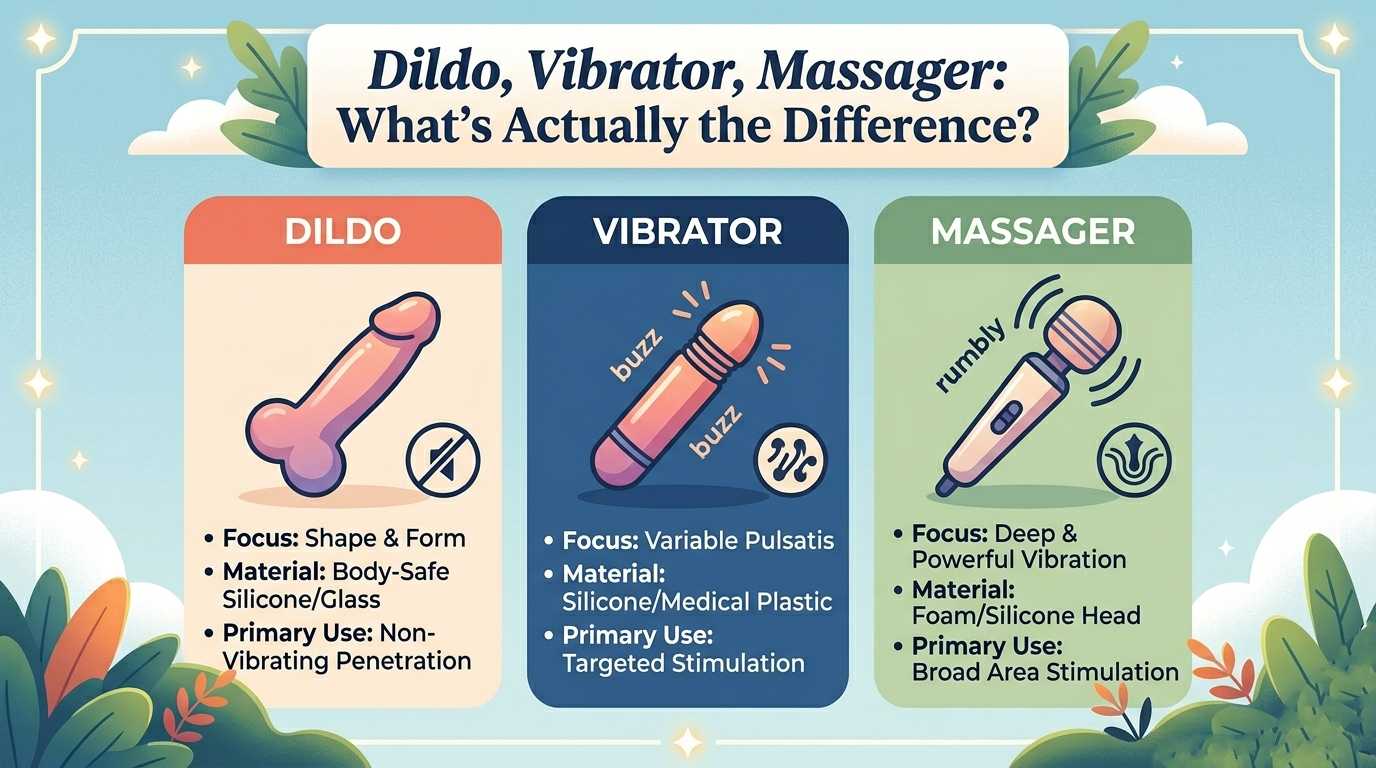
Whether you are exploring for personal pleasure or looking to better understand wellness products, the world of intimate devices can be a bit overwhelming. The terms Dildo, Vibrator, and Massager are often used interchangeably, but they serve distinct purposes and offer different experiences.
Here is a breakdown of what sets them apart.
1. The Dildo: Focus on Form and Sensation
A dildo is a non-vibrating device designed primarily for penetration. Because it lacks internal motors, the focus is entirely on the shape, size, and material.
- Primary Function: Manual penetration (vaginal or anal).
- Key Features: They come in a vast array of materials, from body-safe silicone and glass to polished wood or stainless steel.
- Why Choose It? It is ideal for those who prefer the sensation of fullness without the “buzzing” feeling of a motor. They are also waterproof and very easy to clean since they have no electronic components.
2. The Vibrator: Focus on Stimulation
A vibrator is an electronic device that uses one or more internal motors to create rhythmic pulses. While some are shaped for penetration, many are designed specifically for external use.
- Primary Function: To provide targeted stimulation via vibration.
- Key Features: Multiple speeds, patterns, and intensity levels. They can be battery-operated or rechargeable.
- Common Types:
- Wand Vibrators: Large, powerful devices usually used externally.
- Bullet Vibrators: Small, discreet, and highly targeted.
- Internal Vibrators: Shaped for penetration while simultaneously vibrating.
3. The Personal Massager: The Versatile Middle Ground
“Massager” is often used as a broad term. In many contexts, it refers to high-powered wand-style devices that were originally marketed for sore muscles but became famous for their effectiveness in personal wellness.
- Primary Function: Broad-surface stimulation and muscle relaxation.
- Key Features: Typically larger than standard vibrators with a “head” that distributes vibrations over a wider area rather than a pinpointed spot.
- Why Choose It? If you find small vibrators too “pinchy” or sharp, a massager provides a more rumbly, deep-tissue sensation that many find more comfortable and effective.
Quick Comparison Table
| Feature | Dildo | Vibrator | Massager |
| Power Source | None (Manual) | Battery / Rechargeable | Plug-in / Rechargeable |
| Vibration | No | Yes | Yes (Deep & Powerful) |
| Primary Use | Penetration | Targeted Stimulation | Broad Stimulation |
| Material | Silicone, Glass, Stone | Mostly Silicone / Plastic | Silicone / Foam Head |
Which One is Right for You?
Choosing between these depends on your specific goals:
- If you value texture and physical presence, a dildo offers the most variety in shape and material.
- If you want speed and variety in sensation, a vibrator allows you to experiment with different pulse patterns.
- If you prefer powerful, deep vibrations that cover more surface area, a massager (specifically a wand) is often the gold standard.
Regardless of your choice, always prioritize body-safe materials (like medical-grade silicone) and use a high-quality, water-based lubricant to ensure a comfortable and safe experience.
Frequently asked questions:-
Usage & Technique
- How do I choose my first vibrator? Start with a versatile, medium-sized device or a small bullet vibrator to explore what sensations you prefer.
- Can I use a massager for actual muscle pain? Yes, wand-style massagers are excellent for neck, shoulder, and back tension.
- Is it normal to feel a “numb” sensation after use? Yes, high-frequency vibrations can cause temporary desensitization; it usually fades within minutes.
- Do I need a harness for all dildos? No, only dildos specifically designed with a flared “suction” base or those made for strap-on play require one.
- How long do rechargeable vibrators usually last? Most high-quality devices offer 60–120 minutes of use on a single charge.
- Can I use these products while pregnant? Generally, yes, but it is always best to consult your doctor to ensure there are no specific health risks for your pregnancy.
- What is a “G-Spot” vibrator? These feature a curved tip designed to apply targeted pressure to the anterior wall of the vagina.
- What is a “Clitoral Suction” toy? These use air-pulse technology to mimic the sensation of oral stimulation without direct contact.
- How do I know if a device is too powerful for me? If the lowest setting feels uncomfortable or “stinging,” look for a device with a “rumbly” rather than “buzzy” motor.
- Can these products be used for partner play? Absolutely. Vibrators and massagers are popular tools for enhancing shared intimacy.
Safety & Hygiene
- How do I tell if a material is “body-safe”? Look for “100% Medical Grade Silicone,” “Borosilicate Glass,” or “Stainless Steel.” Avoid “Jelly” or “PVC.”
- What should I do if my silicone toy feels sticky? This often happens if silicone-based lube was used. It may be a sign the material is degrading and should be replaced.
- Can I share my devices with a partner? It is safest not to. If you do, always use a fresh condom on the device and clean it thoroughly between uses.
- How do I sanitize a toy if I’ve had an infection? Use a dedicated anti-bacterial toy cleaner or a 10% bleach solution, followed by a thorough rinse with warm water.
- Are glass dildos breakable? Borosilicate glass is very strong and shatter-resistant, but you should always inspect it for chips or cracks before use.
- Is it safe to use a plug-in massager near water? Never. Only battery-operated or rechargeable waterproof devices should be used in the bath or shower.
- What is “phthalate-free” and why does it matter? Phthalates are chemicals used to soften plastics that can be endocrine disruptors; body-safe toys should always be phthalate-free.
- How often should I replace my device? Replace it if the outer surface is torn, if it emits a strange smell, or if the motor begins to fail.
- Can I boil my silicone dildo to sterilize it? Most 100% silicone dildos can be boiled for 3–5 minutes, but never boil a device with a motor.
- Is it okay to use coconut oil as a lubricant? Coconut oil can degrade latex and some toy materials; stick to water-based options for safety.
Troubleshooting & Maintenance
- Why won’t my rechargeable vibrator turn on? Many devices have a “Travel Lock” feature. Try holding the power button for 3–5 seconds to unlock it.
- How do I store a glass dildo? Store it in a padded pouch or its original box to prevent it from knocking against other hard surfaces.
- Can I overcharge my vibrator? Most modern devices have overcharge protection, but it’s best to unplug them once the indicator light stays solid.
- The motor is getting louder; is it breaking? It could be a loose internal component or low battery. Try a full charge first.
- How do I dispose of an old vibrator? Since they contain batteries and circuits, they should be treated as e-waste and taken to a recycling center.
- What if the charging cable is lost? Most brands use standard USB cables or proprietary magnetic ones that can be purchased separately.
- Do dildos have an expiration date? Not if made of glass or silicone, but they should be replaced if they show signs of physical wear.
- How can I test a device’s volume before buying? Look for “decibel” (dB) ratings in reviews; “whisper-quiet” is usually under 50dB.
- Why is my device getting warm during use? Motors generate heat. If it becomes uncomfortably hot, turn it off and let it cool down.
- Does a higher price always mean better quality? Not necessarily, but higher prices often reflect better motor longevity, body-safe materials, and longer warranties.

